Women in Rust 2025

Caroline Morton

December 19, 2025
What a fantastic year 2025 has been for the Women in Rust community!
Thank you to everyone who has contributed to making this year so special. This was our first full year of events after launching in Spring 2024, and the enthusiasm and engagement from the amazing women in our community has been truly inspiring. I am going to take us back through the year to highlight some of the wonderful moments we shared together. We had 18 events this year with a mix of online and in-person formats. Here are some of the highlights:
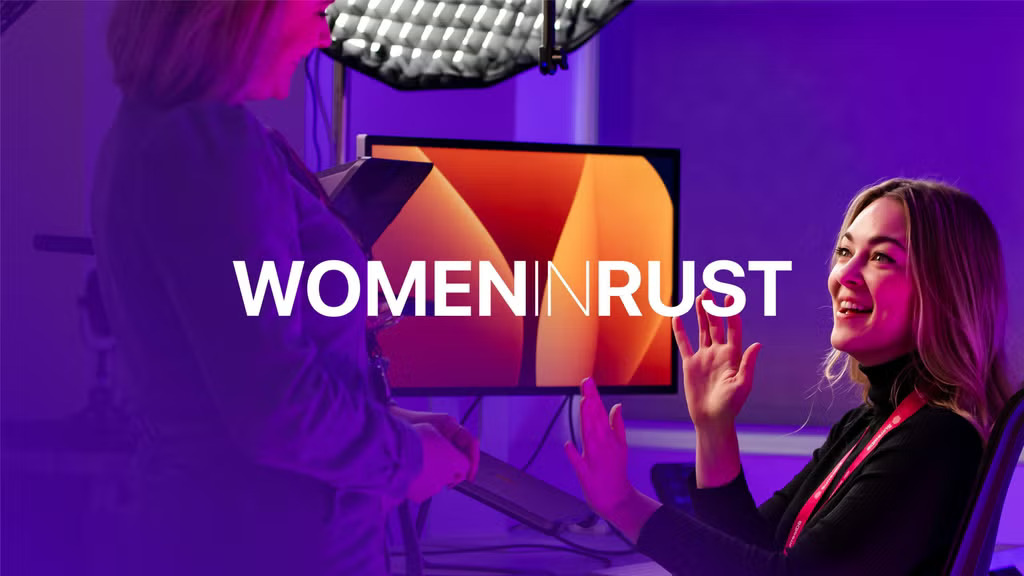
We kicked off the year with our monthly Community Catch Up. These informal online sessions have quickly become one of my favourite parts of Women in Rust. They provide a relaxed space for members to introduce themselves, share updates, and connect with others in the community. This year has been particularly wonderful for me because it has naturally progressed into a supportive group of mid to senior Rust developers who are eager to help each other grow and succeed in their careers. We have talked a lot about being taken seriously as developers, making the transition from mid-level to senior roles, and navigating the challenges of job hunting, career transitions and finding work-life balance. The sense of camaraderie and mutual support in these sessions for me as has been one of the most rewarding aspects of leading this community. If this sounds like something you would enjoy, please do join us in 2026! We are not just for mid to senior developers - all levels of experience are welcome, and we love to support those who are newer to Rust as well.
In February, we hosted a Lunch & Learn session featuring Gabriella Burns and Lisa Crossman, who shared previews of their upcoming talks for Rust Nation UK. Gabriella led a workshop on building an API in Rust, and Lisa highlighted her open source package for genomic data analysis in Rust. It was great to see community members stepping up to share their knowledge and experiences, and we had some fantastic discussions about public speaking and building confidence as a speaker. Lisa is keynoting at Rust Nation UK in 2026 - so do check out her talk if you are attending!
We ended February with a deep dive into the complicated world of strings in Rust, led by Emma Baghurst. Emma was still relatively new to Rust when she delivered this talk, and she did a really great job of breaking down the different string types in Rust, ownership and borrowing, through the eyes of a learner. Her clear visual explanations made some tricky concepts much more accessible. Emma has written up her blog post on this topic, which you can find here. I recently gave a workshop for non rust developers at Lambda World introducing Rust and I used this blog post as a resource for attendees to explore strings in Rust further - it is a great resource! The talk is on Youtube here.

In March, we had the first of two in-person events this year, cohosted with the Women Coding Community. This first event coincided with International Women’s Day, and we had an evening of celebration, discussion and networking in London. Whilst we are mostly an online group, with women from 3 continents attending our events, I really value the opportunity to meet in person when we can. There is something special about being able to connect face to face, share experiences and build relationships in person. We talked about careers in tech, leadership and mentorship, and I loved hearing the different perspectives from women outside the Rust community as well. We finished the evening with some themed cocktails and lots of networking!
Our second in-person event was in April, again cohosted with Women Coding Community. This event focused on finding your voice in tech, with structured career roundtables for early-career, mid-level, and senior professionals. This was a really important event for me personally because I often feel that mid-level developers are overlooked in favour of those who are just starting out. This event provided a dedicated space for mid-level developers to discuss their unique challenges and aspirations, and it was a fun evening all round.
In March, we also had a fantastic Lunch & Learn session with Annika Rings, a senior clinical research scientist who is using rust in her scientific work. Annika introduced us to the SKI combinator calculus and walked us through building a simple interpreter in Rust. This talk is one of our most popular youtube videos to date and I recommend you check it out if you are interested in anything related to interpreters, programming languages or functional programming in Rust.

In May, we had a wonderful session with Laura Sobola, who guided us through the concepts of lifetimes and borrowing in Rust. Laura used practical, real-world examples to explain these often challenging concepts, making them much more approachable. In my experience, lifetimes and borrowing are topics that many Rust developers struggle with, even those coming from other programming languages. Laura gave a great talk that helped demystify these concepts. You can check this out here.
In June, we had another fantastic Lunch & Learn session with Camille Owens who joined us from California (we have gone transcontinental a few times this year!). Camille compared Rust and Python for web scraping, covering libraries, async requests, performance trade-offs, error handling, and production deployment. This was a practical talk that provided great insights for anyone interested in data ingestion and web scraping. This was a great talk for those of us who use Python regularly for data work, and are curious about how Rust might fit into our workflows. From speaking to people in the Women in Rust community, it seems like many of us are coming from data science or data engineering backgrounds, so this was very much a relevant topic. A key takeaway from Camille’s talk was that while Python is great for quick prototyping and has a rich ecosystem for data work, Rust offers significant advantages in terms of performance and safety for production-level applications.
July saw us trying a new format of lightning talks, where community members shared their favourite crates, macros, debugging tips, and productivity tricks. This fast-paced session was a hit, with a variety of topics covered in a short amount of time. It was great to see so many community members stepping up to share their knowledge and experiences. We had an open call for speakers, and I was so impressed by the diversity of topics and the enthusiasm of the presenters. We are planning to do more lightning talk sessions in 2026, so look out for those!

After a break over the summer, we resumed in September with a special interview with Carol Nichols. Carol is the co-author of The Rust Programming Language book and the founder of one of the first Rust consulting companies, Integer32. This interview was a personal highlight for me, as I have long admired Carol’s work in the Rust community. We discussed her journey into Rust, how she ended up being a co-author of the Rust book, her consulting work, and tips for building visibility in the community. This was a great session, and I can’t thank Carol enough for taking the time to share her insights with us. I know that many in our audience were really inspired by Carol’s story and advice.
In late September, Women in Rust teamed up with Women in Scala for a hybrid event in London. This event featured talks on functional programming in Rust and streams in Scala, followed by socialising (aka Pizza and drinks!). It was fantastic to connect with other women from similar communities. I was able to practice my talk on “Accidental Functional Programming in Rust” ahead of Lambda World, and I received some helpful feedback from the audience. It was great to see the cross-pollination of ideas between the two communities, and I hope we can do more events like this in the future.
In November, we had a technical talk on data-intensive systems in Rust, featuring Jelena Jankovic. Jelena explored Rust’s strengths for data-intensive applications and building databases, covering memory safety, predictable performance, and concurrency patterns. This was a in-depth talk that provided great insights for anyone interested in building high-performance data systems in Rust. Jelena did a fantastic job of breaking down complex concepts into understandable segments, making it accessible even for those who are newer to Rust. We had some great discussions following the talk about the challenges and opportunities of using Rust for data-intensive applications. With so many of us working in data-related fields, this was a super relevant topic for our community. We hope to have Jelena back for another session in 2026!
We finished off the year with our Advent of Code kick-off in early December. This annual event is a fun way to get into the holiday spirit while sharpening our Rust skills. We had a great turnout, with many community members participating in solving daily programming puzzles in Rust throughout December. Thankfully there are only 12 puzzles this year, so it is a bit more manageable than previous years! We have set up templates, GitHub discussions, and community collaboration to support participants here. If you haven’t joined us yet, it’s not too late to jump in and solve some puzzles before the end of the month!
Looking back on 2025, I am incredibly proud of what we have achieved as a community. The enthusiasm, engagement, and support from all our members have been motivating and inspiring. I want to give a special shoutout to my co-lead Lizzie Holmes for her unwavering support and dedication to this community. Can’t wait to see what we can achieve together in 2026!
I also want to give a huge thank you and shout-out to Ned Rudkins-Stow who does such an amazing job managing our events, communications and logistics behind the scenes. Truly we could not do this without you! Thanks so much!
I want to thank our sponsors SurrealDB for their generous support this year. Their sponsorship has helped us to provide free events, resources, and opportunities for our community members. If you are looking for a high-performance, scalable database with a flexible query language, do check out SurrealDB - they are doing some really exciting things in the database space, and it is built in Rust too!
Finally, I want to thank all our community members for being part of Women in Rust. Your enthusiasm, engagement, and support make this community what it is. I am looking forward to another fantastic year in 2026, and I hope to see many of you at our upcoming events!